

Olympics is probably the only sports tournament watched by people around the world, from every country. 11,656 athletes participated in the 2021 Tokyo Olympics- from 12 year-old Syrian Hend Zana to 66 year-old Australian Mary Hanna. But it was no surprise to anyone that US bagged the most medals, followed by China, Russia, Great Britain and Japan. It’s the same countries on the top of the table again and again.
Everyone talks about the economic impact of hosting Olympic games, tourism because of Olympics, the enormous cost of hosting the games etc. What no one talks about is, is the impact of a country’s economy on their Olympic performance.
Think about it, US is the most prolific medal-winning nation in the history of Olympics. What do they have, that other countries don’t?
Population? Possibly. US is the third most populated country and China, the most populated country, gave America a tough competition for the most number of medals. But that can’t be all since India is heavily populated but barely wins any medals.
High level of income? Political system?
I think it’s a combination of the three that gives America this advantage.
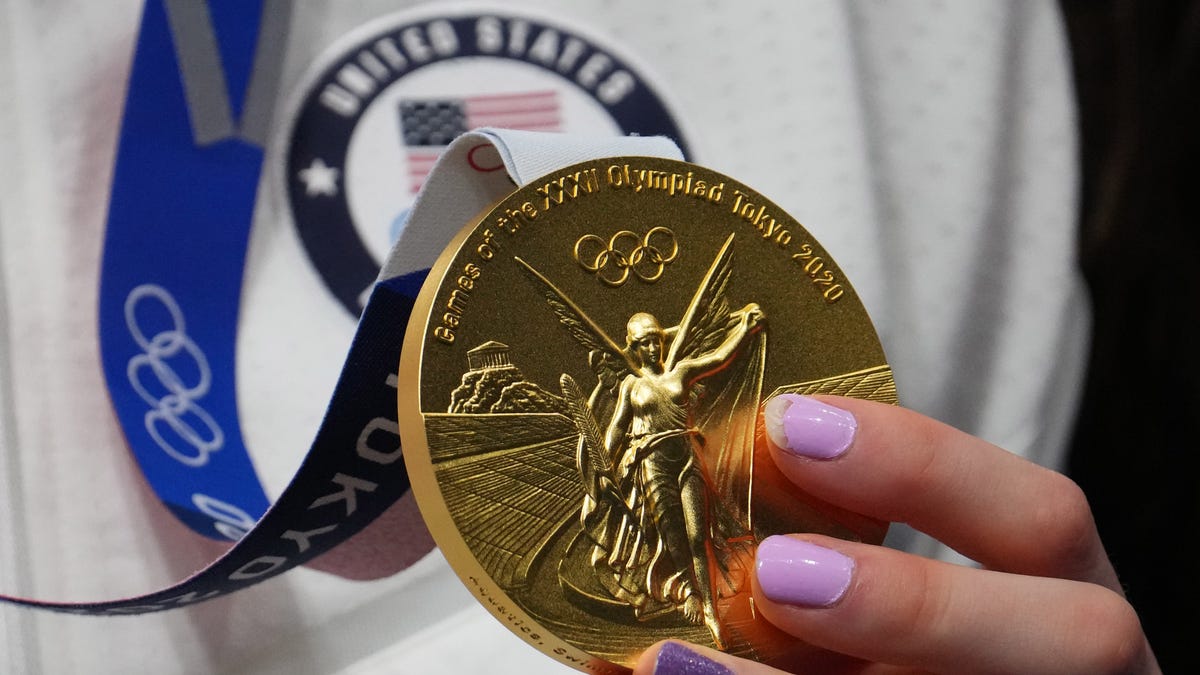
It’s a pattern, in which a few countries are able to win the most medals. Do they share something in common, other than winning the most number of medals in Olympics? Yes.
They have a lot in common actually. All of them are among the most populated countries, they have high Human Development Index (HDI) ratings and have a wealthy economy.
Population is an obvious factor, but it’s not the only one. Larger the population, more the athletes you have to choose from. Not everyone has what it takes to be a world-class athlete. Larger countries have a deeper pool of such athletes and hence a greater chance at winning medals.
However, population levels alone aren’t sufficient to explain national medal totals. Otherwise, India, China, Bangladesh and Indonesia would have won more than 6% of the total medals as they make up 43% of the world’s population (source: scholarly paper by Bernard and Busse). Other measures need to be taken into account as well. This includes the resources available to people of a country. That’s why we take GDP per capita into account.
If we look at it now, China, India, Indonesia and Bangladesh accounted for under 5% of the world’s GDP in 1996, roughly equal to their medal share. Real GDP is the single best predictor of a country’s Olympic performance. (source: scholarly paper by Bernard and Busse)
If a country is very poor they won’t be able to convert their potential into resources. India might have some excellent swimmers but they don’t have any swimming pools, or coaches to teach them breaststroke or butterfly-stroke. That’s why, usually poor countries win at more lower-cost sports like wrestling. The richer countries are able to outperform them by a significant margin in expensive sports like equestrian, fencing etc. (source: scholarly article by Johnson and Ali)
Up till now, we were assuming that the athletes were evenly distributed around the world. However, for Olympic level athletes to emerge, the expenditure on facilities and personnel plays a crucial role. Developed and wealthy countries have more money to spend on such services and include sports in schooling as a serious subject, as opposed to a leisure activity. In countries like India, compulsory physical education in schools isn’t too effective since many schools lack sports facilities and equipment.
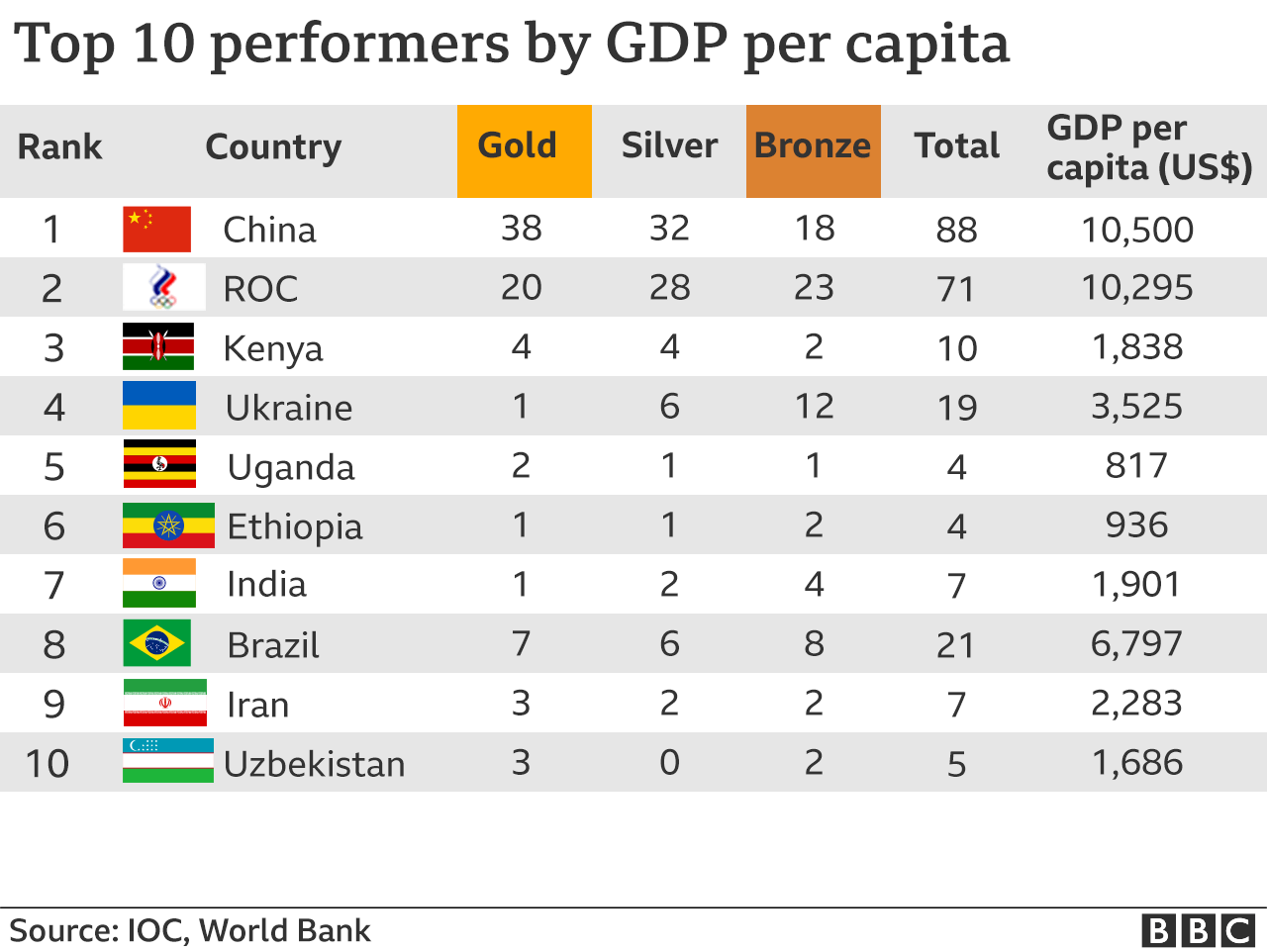
BBC rearranged the Olympic table, taking into account the GDP per capita. It was found that China and Russia did much better. India secured 7th position in this table, while US lagged behind at 15. This indicates the role of wealth.
Money and population aren’t the only factors. The hosting nation also has an edge over others. The transportation costs are lower and they have climatic and training advantages in the competition. Climatic conditions plays an especially important role. It’s observed that host countries typically win an additional 1.8% of the medals beyond what would be predicted by their GDP alone.
Cultural and political factors are important in engaging people in sports from a young age. Countries that belong to the Soviet Union, tend to have an advantage because of the strong sports infrastructure that was established by communist regimes. According to BBC, commonwealth countries also tend to do better than expected compared to their size and wealth. Britain popularised sport while they were in India and bought fan enthusiasm to push the athletes to do better.
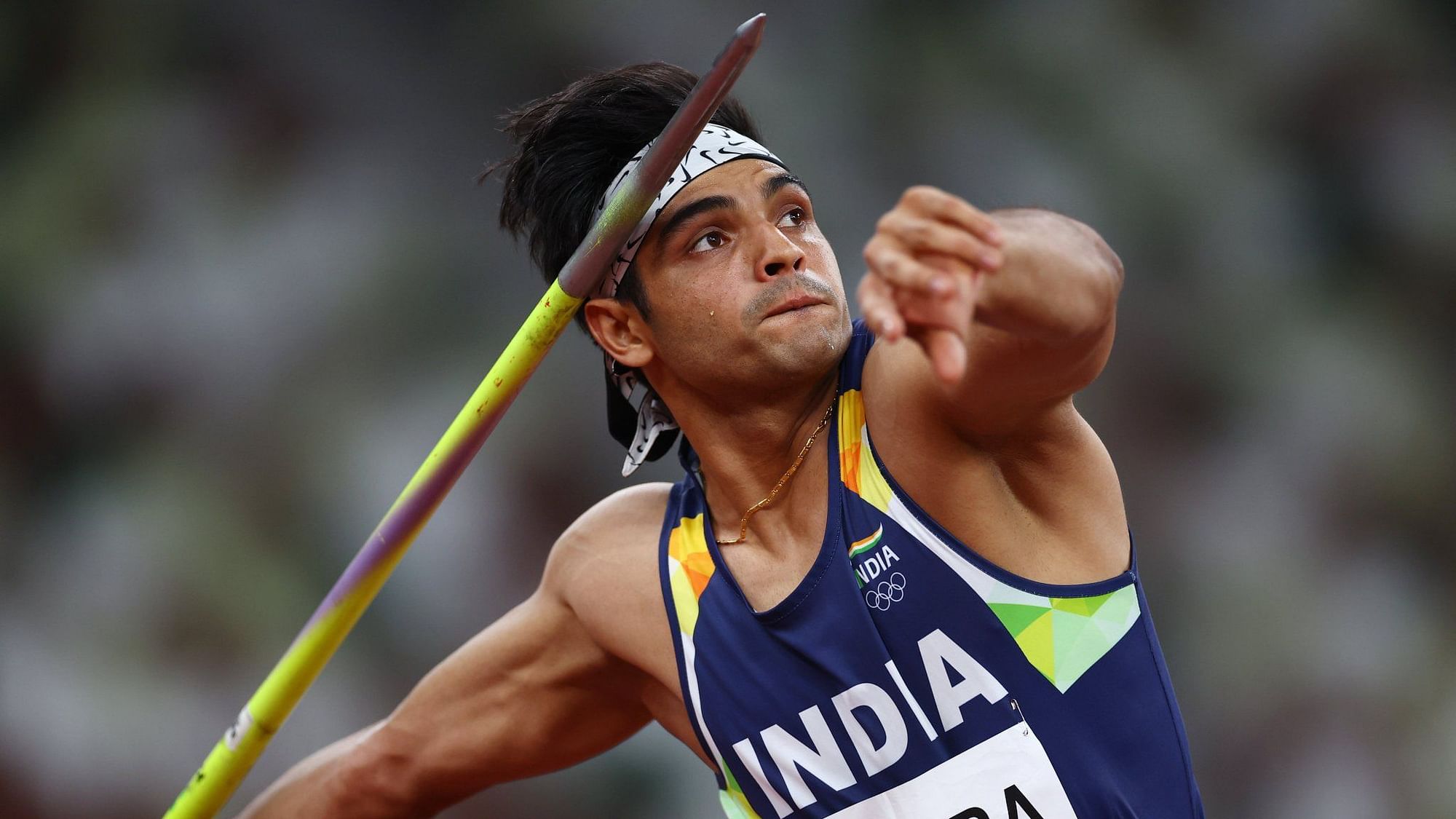
Some athletes are exceptional at certain sports which are popular in their country. Often, countries manage to win at least one medal in such sports. Like India’s forte is cricket. The sad part is, it isn’t an Olympic sport. But think about if it was, India would’ve won medals in the sport and put up a tough competition for other countries. Similarly, US is good at track and swimming.
The games are obviously an indication of the athletic abilities of players. However, it’s also a subtle reflection of the economic development of a country. A country with more money to spend on sports will do better. And only developed countries have the capability to do so.
It’s not an entirely accurate measure as it ignores countries that are improving fast or declining fast. Short-term economic developments cannot be analysed using Olympics.

Fun fact: India’s position in Tokyo’21 was calculated on the basis of the above points and it was predicted that they’ll have their best year yet. They weren’t wrong!




 The Echo-nomist
Leave a comment