
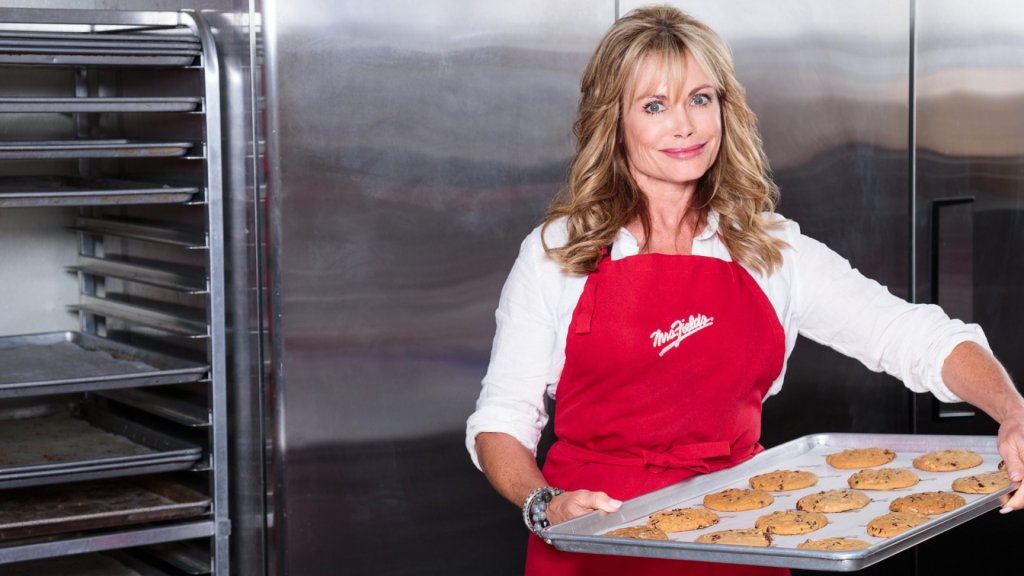
#9- Women Entrepreneur series
Debbie fields had the perfect recipe for chocolate-chip cookies and it wasn’t Nestlé Toulouse’s recipe :p
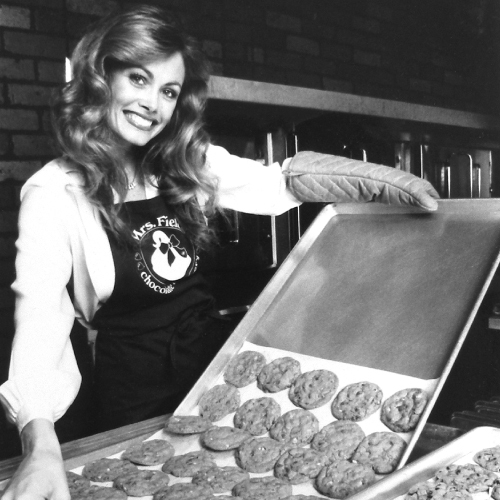
When she was just 20 years old, she opened decided to turn her chocolate-chip cookie recipe into a company. She opened her first Mrs. Fields bakery in 1977 and the rest is history. So how did she make a multi-million dollar business out of cookies and then sell it to an investment firm?
When asked about her success story, she likes to say that she grew up in an extremely wealthy family. Her father made $15,000 per year as a welder for the United States Navy and her mother stayed at home to raise Debbi and her 4 siblings. Their wealth wasn’t monetary. In an interview she talked about how they made every dollar stretch. “My father believed that true wealth was found in family, friends, and doing what you love.” She took that advice very seriously and used it to build an entire empire around a cookie recipe.
Her mother was mostly busy doing the house chores. There can be a lot with five kids in the house! They didn’t have machines like washing machines, dryers, dishwasher etc. Cooking was a chore her mother wasn’t exactly fond of, as was evident in the food she cooked. As a child, Debbi didn’t enjoy eating the food at home and refused to eat many a times. The only thing she was willing to eat was cookies! She used to bake her own cookies using imitation chocolate, margarine and nothing real. They couldn’t afford to have all that.

The cookies she made with budgeted, inexpensive ingredients were nice but not nearly as delectable as the ones with real ingredients. She realised that when she got her first paying job with Oakland A’s basketball organisation at the age of 13. She spent her paycheck on real butter, chocolate and vanilla to up her cookie game.
Thus, Debbi grew up with a passion for baking. However, it wasn’t until she married her first husband, Randy Fields, and settled down that she realised she wanted to forge a career path for herself. As a new wife, she did her duties as a spouse, hosted visitors and made polite conversation. During one such conversation with her husband’s client, she tried to pretend she was a sophisticated person and that conversation convinced her she wanted something else in life. The man asked her, “what do you do?”
In response, she told him she was just trying to get orientated. He got up, pulled an enormous, dusty dictionary off the shelf and handed it to her. He said, “The word is oriented. If you can’t speak the English language, you shouldn’t speak it at all.” In that moment of clarity, with tears streaming down her cheeks, she realised she wanted to be somebody. She didn’t want to be her husband’s shadow. She wrote in her book, One Smart Cookie, “somehow I would have to change, to become an independent, self-respecting individual able to stand on my two feet.”

She decided to start her business based on a skill she acquired as a little girl. She had been baking delicious chocolate chip cookies for her friends and family since she was merely 13 years old. As a 20 year old. she improved and perfected the basic recipe by Toll House.
Her husband’s business acquaintances adored her cookies. She mustered up the courage to ask them what they thought about making a business out of these cookies. Mouth full of cookies, they said “bad idea,” “it will never work.” Debbi’s friends, family, in-laws told her the business would fail. She has talked about how her parents told her she had no idea going into the cookie business, without any formal education and money. It just wasn’t going to work according to them. Everyone thought she was crazy!
These aren’t the encouraging words that an aspiring entrepreneur wants to hear. But instead of letting it discourage her, hearing these words only made her more determined. She went from bank to bank, offering them her cookies along with her business plan and asking for a loan. They would go through the plan, eat the cookies and say, “thanks, but no.” She was rejected by a lot of banks and wasn’t able to get approved for a loan. Remember, this was the 70s. Women in business wasn’t that common. Forget about a woman starting her own businesses.
Debbi and her cookies finally got approved for a loan with a whopping interest of 21%. But that was thrilling after all the loan rejections.
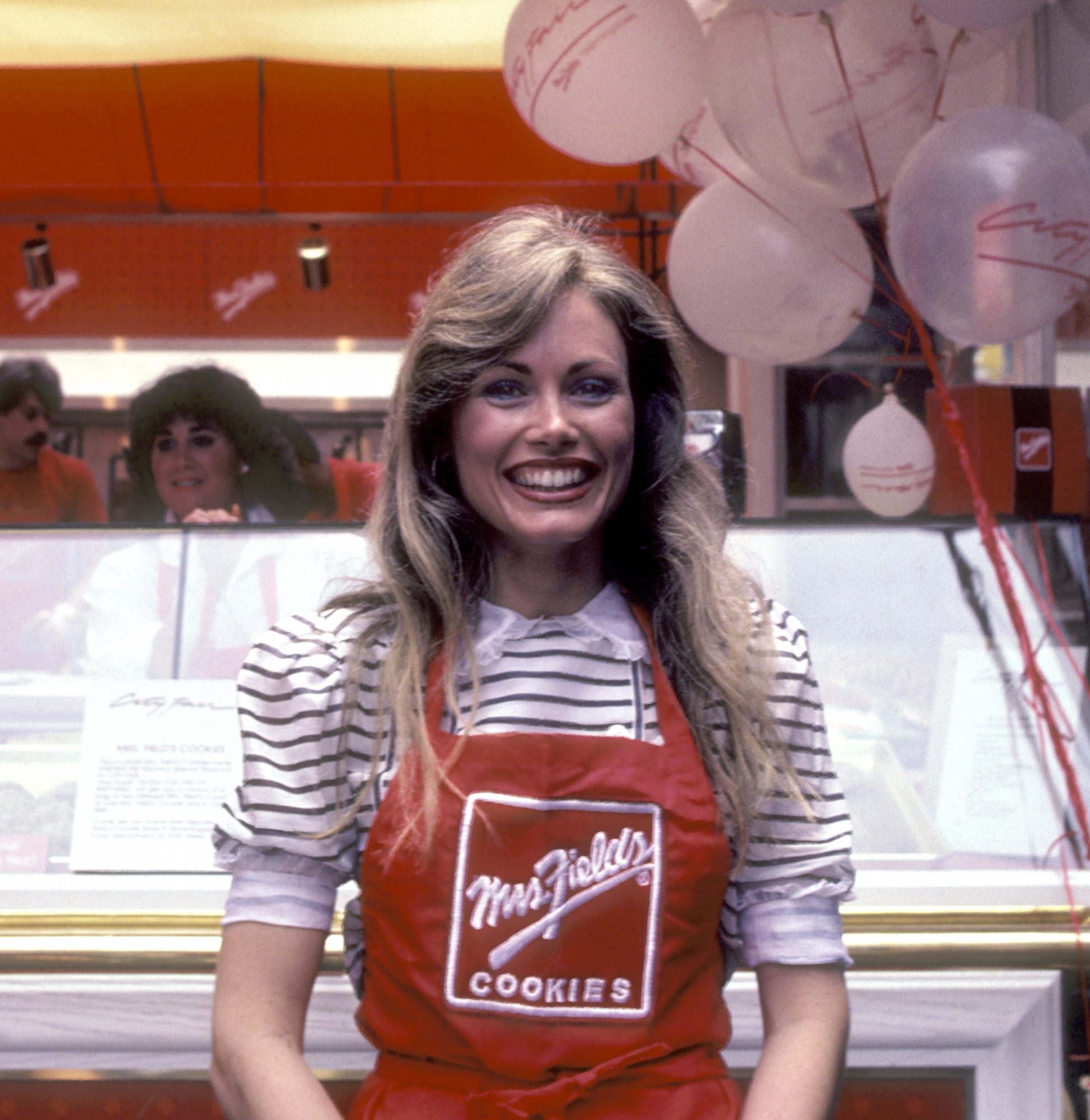
Her husband went along with the idea but he wasn’t so sure about its success, and deep down didn’t believe his wife could succeed in the business world. In his defence, market studies showed that the consumers strongly preferred crispy cookies. Debbi’s cookies were large, soft, and larger than normal and would have to be sold at much higher prices than the regular bakery cookies.
So at age 20, Debbi fields inaugurated her first store in Palo Alto, California on August 18, 1977 at 9:00am. No one in that store had any idea just how successful it was going to be one day. In fact, her husband bet she couldn’t make $50 in sales on the first day. Of course, she took that bet.
She sat in the store on the opening day, waiting patiently for customers to come. However, by noon, no one had bought a single cookie. She realised she was going to lose the bet. In an attempt to attract customers, she took to the streets. She offered samples to passerby’s. They like them so much that they returned to actually buy the cookies. Free samples was a strategy that she would use to attract new customers in the coming years. At the end of her first day, she sold cookies worth $75.
From that day on, she learnt that failure means something isn’t working and she needs to try something new instead. She structured her business in a way that she gets immediate feedback on whether or not she was failing. For this, she sat down and worked out how much she needed to earn in a month, a day and an hour. It came out to approximately $32 per hour. The strategy of hourly goals is something the company used even as it grew.
She quickly gained popularity among market goers and locals. Warren Simons, the builder behind San Francisco’s Pier 39 shopping area, offered Debbi a space for a second shop just a year after she opened the first. At first she said no to the opportunity. In 1979, she got approved for a loan which much more ease. Second time’s the charm. Using the funding, she opened a store at Pier 39 after her employees became impatient for growth opportunities. Her second store was so successful that the long lines caused problems to nearby businesses!

The company faced an early crisis which they soon recovered from. But the crisis illustrated the company’s way of thinking. Debbi fields refused to replace higher cost raisins with less costly and less tasty dates. Quality was of utmost importance to her. She set up a policy which she follows till date. The cookies had to be warm and fresh. When they were two hours out of the oven, what hadn’t been sold was donated to the Red Cross to be given to blood donors or other deserving charities, and Mrs. Fields baked a new batch.
She believed in making her customers feel important. She learnt their names, how they liked their coffee and their choice of cookie. When her customers started calling in sick, she new she had more than just a bakery.
Soon the company had three stored but it was becoming exhausting. In order to maintain the quality and customer relations, Debbi was working 16 hours a day and had to schedule times to meet her husband!
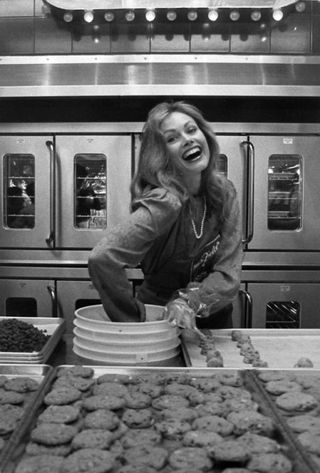
Not all of their new stores were equally successful. They opened a store in the Ala Moana Shopping Center in Honolulu. Initially, it failed miserably. But since the priest of the native Hawaiian culture blessed the store, crowds of cookie buyers appeared. Ever since, it has been on their busiest stores.
For several years, Debbi resisted franchising her stores. She realised cookies and other products could be duplicated but not the atmosphere of “love and caring” that was so important for the business. Slowly, but steadily, she changed her strategy and opened new stores. She introduced 14 different kinds of cookies and five kind of brownies.
In 1987, Mrs. Fields’ Cookies earned a profit of 18.5% on sales of $87 million, up from $72.6 million in the previous year (source: Funding Universe). In the same year, the company purchased La Petite Boulangerie, a chain of 119 French bakeries from PepsiCo for $15 million! Randy developed a software for his wife to reduce Le Petite Boulangerie’s administrative staff from 53 to just three people. Randy and Debbi worked together in the years to come as he developed many innovative software’s to expand their cookie business.

The firm equipped each store with computers containing their software that were linked by modems to the company’s larger system in Park City. Computerization allowed the firm to plan production schedules, monitor stocks, order raw materials, communicate with headquarters, handle payroll and accounts among other tasks. It improved management and control and coordination between different branches.
Randy, too, found success with his wife. After he computerized Mrs. Fields’ Cookies, he began selling his AI/store management software through a subsidiary, Fields Software Group. The Burger King Corporations became one of their customers in 1990!
The company did have their bad times in the middle. In 1988, they lost $19 million and closed 85 of its 500 stores. No one’s sure why this happened. Some blame the fast expansion. Other suspect that these problems began in 1986 with the company’s IPO on London’s Unlisted Securities Market. The investors in Britain purchased only 16% of the 30 million shares offered at $2.46 per share. After they declared a $15 million reserve to pay for closing stores, their share price decreased to just 44 cents per share!
In 1989, the company rebounded from its poor performance in the previous year. Revenue for Mrs. Fields’ Inc. increased 8% to $129.7 million, and the firm recorded a net income of $1.5 million. A major improvement from their loss of $19 million in 1988.

In 1990, Mrs. Fields’ Cookies announced an agreement with Marriot Corporation which allowed Marriot to own at least 60 stores and sell and bake their popular bakery product. They expanded internationally in the 90s with 45 stores outside the US. Debbi, herself, worked on remodeling stores to make space for new packaging products, cookie jars and tins. They tied up with teddy bear maker Gund to make little bears like those on the cookie jars. This stimulated cookie buying, as well as gift purchases. She experimented with new designs and decors, eventually settling on a European-style café which was colourful and exciting.
In 1993 they removed the company’s stock from the LSE and their new owners reorganized the company. Four lenders, mainly the Prudential group, acquired 80% of the firm in exchange for writing off $94 million in company debt, and Debbi remained as a minority interest. She remained the board chairman and accepted a salary cut of $150,000 to $450,000. Thomas Fey replaced Debbi as the president and CEO. This change in the company allowed them to expand and open 100 new company-owned franchised stores within the next year!
Debbi and Randy started the Mrs. Fields’ Cookies family but ended theirs in divorce. She had five daughters, just like her mother. She talked about how being out of the business is like empty-nest syndrome.

Her official time at Mrs. Fields came to an end in 2000. However, in the years since, she has been a spokesperson. She still talks to the owners but she still missed the customers and the business.
Even though she doesn’t run the show anymore, her story inspires women and young girls around the world. Using a recipe she mad as a teenager, she started a business at the age of 20, defying all odds. It wasn’t easy to secure funding or gain people’s confidence but she did it nonetheless. She told Inc., “There are many things to be excited about in my life, but my heart will always tug at being at the helm. I’m a born entrepreneur.”




 The Echo-nomist
Leave a comment