
Aborting abortion may be injurious to the economy…
On June 24th, the US Supreme Court overturned Roe v. Wade, the landmark 1973 Supreme Court decision that affirmed the constitutional right to abortion. The constitutional right protected abortion access up until the point that the foetus could live outside the womb- typically set at 22 or 24 weeks of pregnancy. The outcome of the current case did not come as a surprise to everyone since an initial draft of the opinion was leaked to the news outlet Politico in May.
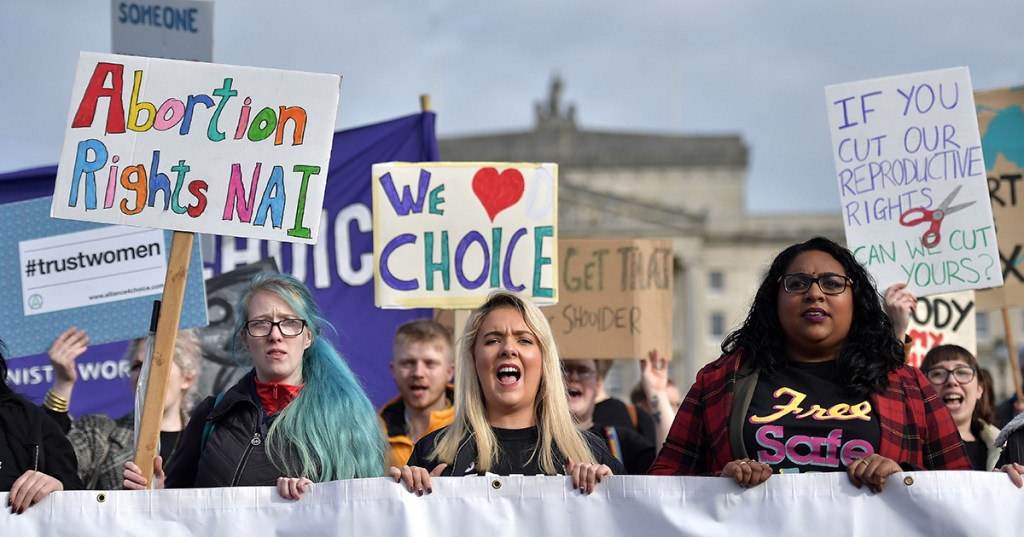
There has been an outburst of protests against this decision of the court. However, some people also support this decision. Regardless of which side of the debate you lean towards, the issue of access to abortion is not merely a social issue but also an economic issue with far reaching impacts.
First things first, what is the story behind Roe v. Wade?
In 1970, Dallas lawyers Sarah Weddington and Linda Coffee were in search of the perfect plaintiff for their attempt to challenge Texas’ abortion laws. Out of other options and unable to afford to pay for an illegal abortion, 21 year old McCorvey turned to those Dallas lawyers. She became pregnant for the third time and was living in her home state of Texas. She hoped to get an abortion; however, Texas laws only allowed abortions if carrying the foetus to term threatened the mother’s health. She was just the person Weddington and Coffee were looking for. It was a perfect situation.

McCorvey’s lawyers filed the case at a federal district courthouse in Dallas on March 3rd, 1970. To protect her identity, the lawsuit anonymized McCorvey as “Jane Roe.” The second half of its name refers to the defendant, Henry Wade, the district attorney charged with enforcing Texas’ abortion laws. Hence, Roe v. Wade.
Coffee and Weddington argued that the current abortion laws violated women’s constitutional right to privacy. The district court ruled in the pair’s favour, but they dismissed their request to stop enforcing the state’s old abortion laws. Both the plaintiff and defendant were unhappy with the decision and appealed the decision to the Supreme Court. The lawyers went on to present their arguments to the all-male Supreme Court on December 13th, 1971. By then, Coffee and Weddington had made Roe into a class-action suit, demonstrating the case for the constitutional right of all Americans to determine the path of their own lives. Eventually, the court issued its ruling on January 22nd, 1973, effectively legalizing abortion across the country by a 7-to-2 majority.
By the time the court ruled on Roe, McCorvey’s pregnancy had long ended. She wasn’t able to have an abortion and gave birth to a baby girl. She subsequently gave the child up for adoption. While irrelevant for McCorvey, Roe v. Wade was pivotal for other women.

Back to present day, the supreme court overturned Roe v. Wade, taking away the constitutional right to abortion. Each state can come up with their own laws regarding abortion, and more than half the states are expected to ban abortions or impose heavy restrictions. In anticipation of the decision, 13 states passed trigger bans. The trigger bans were passed a few days ahead of the supreme court’s decision and are designed to be “triggered” and take effect automatically or by quick action.
The average woman seeking an abortion in America is on a low income, in her 20s, and already a parent. 49% of abortion patients live below the federal poverty level, and 60% of abortions are obtained by women in their twenties (source: Guttmacher Institute). Furthermore, poor women are five times more likely to experience an unwanted pregnancy, according to the Brookings Institution.
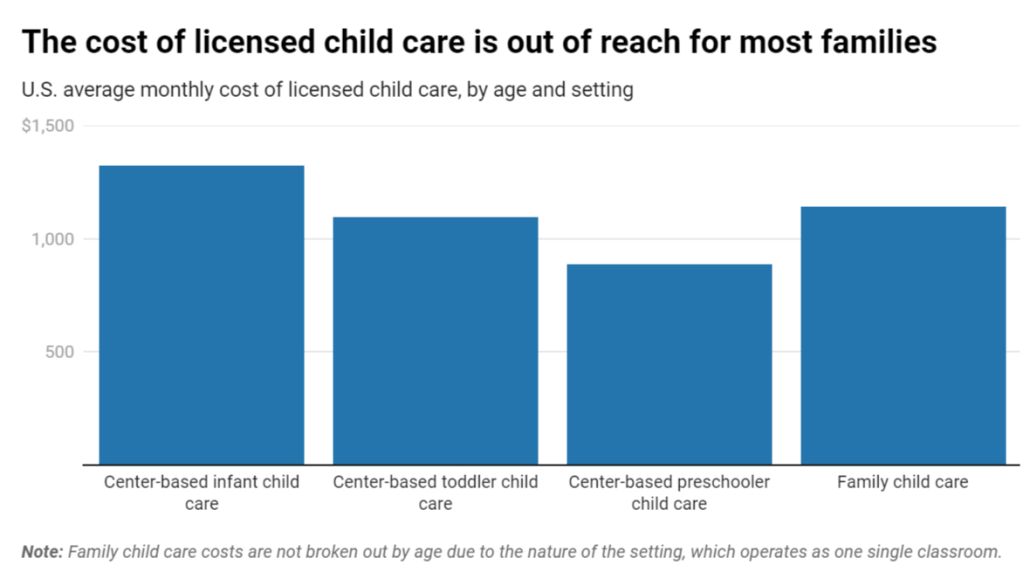
Abortion is not a cheap option, with costs ranging from a few hundred dollars for an abortion pill to $750 for medical procedures later in the pregnancy (source: Planned Parenthood). However, the cost of giving birth and raising a child far exceeds this amount. Even those with health insurance are required to pay, on an average, $4,500, to give birth (source: Atlantic). And this cost just increases after birth. On average, childcare in the US costs about $1,300 per month per child! There is an interactive on www.costofchildcare.org that goes into detail about the average cost of raising a child.
Across the southern states, where anti-abortion laws have already been triggered or are in the making, 20%-30% of the children are living in poverty. This is four to six times the national average of 5.6%. Unless the cost of birth and child welfare is drastically altered, the poverty rate will rise in the absence of abortion.
While younger women may be closing the wage gap in major cities, the gains they make diminish once they have children, when women’s wages drop due in part to bias, discrimination, and lack of support infrastructure. Recent data from the National Women’s Law Center shows that mothers working full time, throughout the year outside the home are paid 75 cents for every dollar paid to fathers. This gap only widens based on race and ethnicity- Latin mothers are paid 46 cents for every dollar paid to white, non-Hispanic fathers, Native American mothers are paid 50 cents, Black mothers are paid 52 cents and white, non-Hispanic mothers are paid 71 cents (source: Forbes).
Upon examining data on men and women’s earnings, a trend can be noticed: their earnings tend to be pretty similar up until the point they become parents. The men’s earnings are not impacted. In fact, they even increased slightly for some. For women, it falls off a cliff, and it can take forever to climb back. Further, the cost of child-bearing has risen as a result of the pandemic. All of these factors contribute to decreasing the earning potential of women in the event that abortion is banned.

Other than affecting individual families, denying abortion can also have a much wider impact on the state’s economy. Janet Yellen, the US Treasury Secretary, testified to the Senate last month, reversing reproductive healthcare access in some states would have ‘very damaging effects’ on the national economy. Before the ruling, the Institute for Women’s Policy Research (IWPR) calculated that abortion restrictions cost state economies $105 billion a year by reducing labour force participation and earnings levels and increasing turnover and time off from work among women ages 15 to 44 years. An additional 505,000 women from that age gap would enter the labour force if all state-level abortion restrictions were removed, and they would earn about $3 billion, while women ages 15-44 who are already employed would collectively earn $101.8 billion more annually. As a result, the States’ national GDP would climb nearly 0.5%, according to IWPR. Research by Myers, Caitlin Knowles shows that the expansion of abortion access in the 1970s was directly linked to increased educational attainment, greater labour force participation, and higher earnings. So, being denied an abortion is a lose-lose situation for women and states.
The Turnaway study was conducted at the University of California, San Francisco, wherein they followed 1,000 women who sought abortions for five years. According to their findings, women who were denied abortion access went on to give birth and experienced an ‘increase in household poverty, lasting at least four years relative to those who received an abortion.’ They also mentioned that years after being denied an abortion, women were more likely to not have enough money to cover basic living expenses like food, housing, and transportation. Being denied an abortion lowered their credit score and increased the woman’s debt. They also saw an increase in the number of negative public financial records like bankruptcies and evictions.
This ban is also bound to have consequences for the next generation- both economic and emotional. According to the findings of the abovementioned study, carrying an unwanted pregnancy to term is associated with poorer maternal bonding, such as feeling trapped or resenting the baby, with the child being born after abortion denial, compared to the next child born to a woman who has had an abortion. The Children’s Defense Fund has also found that poor children are more likely to have ‘poor academic achievement, drop out of high school and later become unemployed, experience economic hardship, and be involved in the criminal justice system.’ Hence, because of the Roe v. Wade ruling, already vulnerable women and their families may slide even faster down the ladder.
The Guttmacher Institute found that about $4 was saved by public medical and welfare providers for every tax dollar spent to pay for abortions for low-income women. This included Medicaid expenditures for prenatal care, delivery, and postnatal care; early childcare; and food stamps. This varied from state to state, from a 9-to-1 benefit-to-cost ratio in Massachusetts to a 2-to-1 ration in Hawaii. Furthermore, if abortions were publicly funded in every state for two years, the country would save $339.6 million. (source: Guttmacher Institute).
Texas, for example, suffered $14.6 billion in economic losses even before it enacted the six week ban on abortion, according to IWPR. Missouri’s GDP would also rise 1.02% if it weren’t for abortion restrictions.

In light of the Supreme Court’s decision, many corporations have added abortion benefits to their healthcare coverage or confirmed that existing plans will cover any necessary travel costs to access abortion. Some companies had begun to cover abortion travel expenses before this year, seeing an increase in the state-level restrictions on these procedures. Others introduced this benefit in response to the leaked draft of the Roe v. Wade ruling. Given the enormous economic and emotional cost of denying abortions, companies will be forced to live up to these promises and commitments to support women. Some of the major corporations that have provided abortion benefits are: Amazon, Apple, Dick’s Sporting Goods, Disney, HP Enterprise, JPMorgan, Levi’s, Meta, Netflix, Tesla, Reddit, Starbucks, etc. Women are their employees. These companies want their employees to make the most efficient decision and to get back to work and be productive. They are willing to incur these short-term costs for employees to get an abortion rather than avoid the long-term costs that they know are there. They realise the economic and financial impact that banning abortions could have. However, companies need to be careful with these provisions.
Economics of Abortion in Court

There are also people who have competing views on the economics of abortion. A group of 240 female researchers who oppose abortion filed an amicus curiae in the case. An amicus curiae is a legal document supplied to a court of law containing advice or information relating to a case from a person or organisation that is not directly involved in the case. In the one filed in the Dobbs v. Jackson Women’s Health Organization, the researchers argued that abortion access had set women back after Roe. Legalization. They argued that it coincided with more women falling into poverty, women reporting lower levels of happiness in surveys, and fewer women saying they were in satisfying long-term relationships. Catherine Pakaluk, an associate economics professor at Catholic University, who signed the brief, argued that this approach to this issue is incomplete because it avoids considering the benefits and success of those who were never born.
In response, a group of 154 economists, led by Prof. Myers, filed their own amicus curiae, pointing to “a substantial body of well-developed and credible research” that contradicted the anti-abortion belief. They argued that in giving women control over their childbearing preferences, abortion legalization led to a range of social and economic benefits for women, particularly relating to education and work.
For now, the decision regarding banning abortion rests in the hands of the states. However, the struggle for women’s rights is far from over.



 The Echo-nomist
Leave a comment