
Post-pandemic recover isn’t exactly going smoothly. Air travel can relate to that as it comes with its own set of turbulences. Lost luggage, delays, last minute cancellations and general chaos was the defining point for many people’s flying experiences. The problem seems to be worse at London’s Heathrow Airport, where it has reached its saturation point. There is insane chaos at the baggage reclaim systems of the airport…
Travel recovered quicker and faster than airports anticipated and they were not ready for it. However, despite the widespread inconveniences and cancellations and rising prices because of inflation, consumer demand for travel remains robust, for now. The demand isn’t very elastic because people are desperate for a vacation after two years and it’s the season for students to travel abroad for university.
It’s the season of ‘Airmageddon.’
That’s the name that has been given to the chaotic reality of summer travel, with airlines and airports bracing for potential meltdown and travelers suffering stressful experiences.

Heathrow Airport, among others has told airlines to stop selling summer tickets as UK’s biggest airport struggles to cope with the rebound in air travel. They announced a 100,000 daily cap on passengers until 11 September now, putting thousands of customers’ plans in jeopardy.
The question arises, why?
Of course a lot of this has to do with lifting coronavirus travel restrictions across Europe. This resulted in a surge in demand as airlines, airports and other travel-related companies struggle to staff their operations sufficiently after laying off thousands of workers at the peak of the pandemic. The travel and aviation industry was one of the most affected due to the pandemic and was practically ground to a halt over the last two years.
Lack of staff couples with the war in Ukraine has led to flight delays. The war is severely restricting available airspace across the continent and causing massive bottlenecks in the skies.
The airport and airline staff also directly comes in contact with numerous passengers every day, increasing their infection rate and hence sick days. This hampers their ability to stick to their flight schedules.
In the UK, there is another contributing factor. To meet the shortage in staff, they can not draw on the pool of European Union (EU) workers after Brexit. Many of the airline workers who were laid off during covid, went back to their respective countries and haven’t returned to the UK since. This has led to a shortage in workers not just in the aviation industry but in other areas as well, such as the truck/lorry driver shortage.
Even if there are people willing to work, more often than not, there is some fairly complicated training involved actually doing the work. So the shortage of staff can’t be instantly taking care of with an influx of new workers. Laying people off is easy, hiring and training people is hard…
The cherry on top is several European airport and security worker unions going on strike seeking better pay! The union said the action was due to a 10% pay cut imposed during the peak of the pandemic not being reinstated, despite business going back to pre-covid levels. Furthermore, the 10% pay cut was restored for the managers but not for members of the union.

Cancelled flights
There has been a wave of preemptive cancellations, made over the past weeks, which will affect tens of thousands hoping to get away from the summer from Heathrow and Gatwik. Even this won’t be enough to successfully deal with the mess.
To cope up with the chaos and demand, airports are asking airlines to cancel flights. British Airways said that it was cutting more than 10,300 short-haul flights between August and October. Nearly 30,000 flights have been removed from the British Airways’ (BA) schedule between April and October this year. (source: BBC)
BA has continued to promote and sell flights that it could not even fulfill. As a result, thousands of customers have faced the chaos of cancellation in recent weeks.

This is a problem that’s affecting travellers across Europe. Aviation authorities cacelled 17% of flights out of the Paris airports on 1st July and another 14% on 2nd July due to airport workers’ strikes. Air France was forced to cancel 85 flights on one day due to the strike at the Charles de Gaulle airport.
Airports in Spain have also been struggling. The main Spanish airline Iberia, recently revealed that delays at Madrid’s Barajas Airport have led to nearly 15,000 passengers missing their flights in the last weeks.
Amsterdam’s Schiphol Airport has experiences hour-long lines, thousands of flight cancellations and thousands of bags missing and lost. Germany airports’ are also experiencing many of the same problems due to their shortage of pilots, flight attendants, baggage handlers and other employees.
Long lines are also adding to the problem, as 1000 people missed their flights on a single day in Ireland’s main airport, due to long queues.
Baggage Mountain
Meanwhile, the Heathrow airport is also dealing with the problem of lost luggage. Suitcases have been piling up in Heathrow’s baggage claims after a glitch with the airport’s luggage system. They took care of the glitch and fixed it in a few hours. However, the damage had been done. It had caused a delay in delivering luggage to people as baggage started to pile up in the airport. Already overwhelmed and short of staff, they weren’t able to deliver all the luggage to their respective owners, resulting in what has come to be known as “baggage mountain.” It’s made up of countless rows forming one giant cluster containing hundreds, maybe thousands of bags.
Some passengers have been waiting for their luggage for over a week!
The problem became so extreme that Delta Airlines had to send a plane to Heathrow Airport just to flyback 1,000 pieces of stranded luggage and zero passengers. Desperate times call for desperate and some what tragic measures.
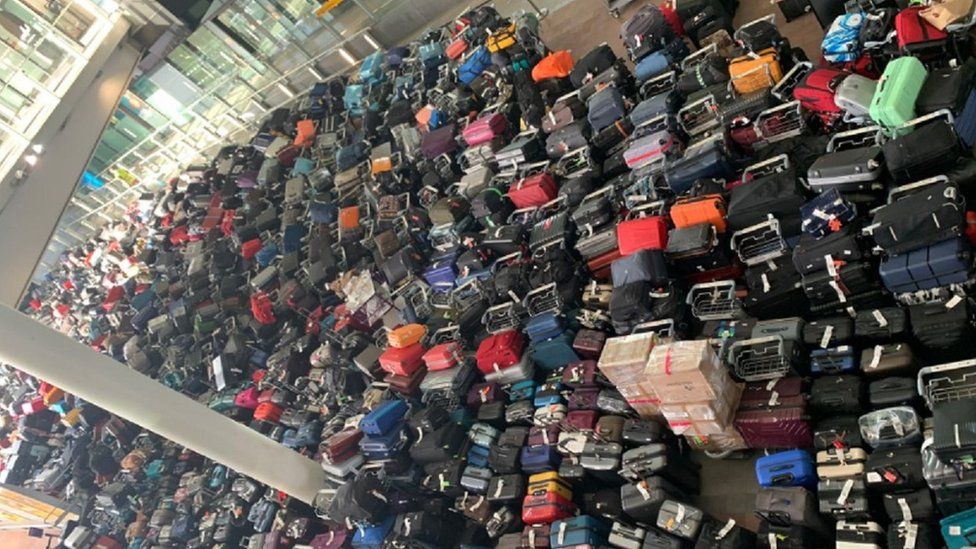
Delta decided to send the plane to deliver luggage that had been stranded at the Heathrow airport to Detroit. The luggage belonged to their customers who had recently traveled through Heathrow and were separated from their bags because of travel disruptions. From Detroit, the airline transported the bags to their respective owners. A Delta spokesperson, Morgan Durrant, described this move as a “creative solution to accelerate the movement of delayed bags.”
It stinks!
The luggage has been laying around for so long, that travellers at the airport have been complaining about the smell coming from the piles of unclaimed luggage. Since it has been piling up for so long, there is an unpleasant odour coming from the cases. One passenger compared the smell at the airport to the smell of “festering bush meat.”
Another traveller said that the area “stinks of poo or dead animals!”
TikTok is making things worse for Heathrow…
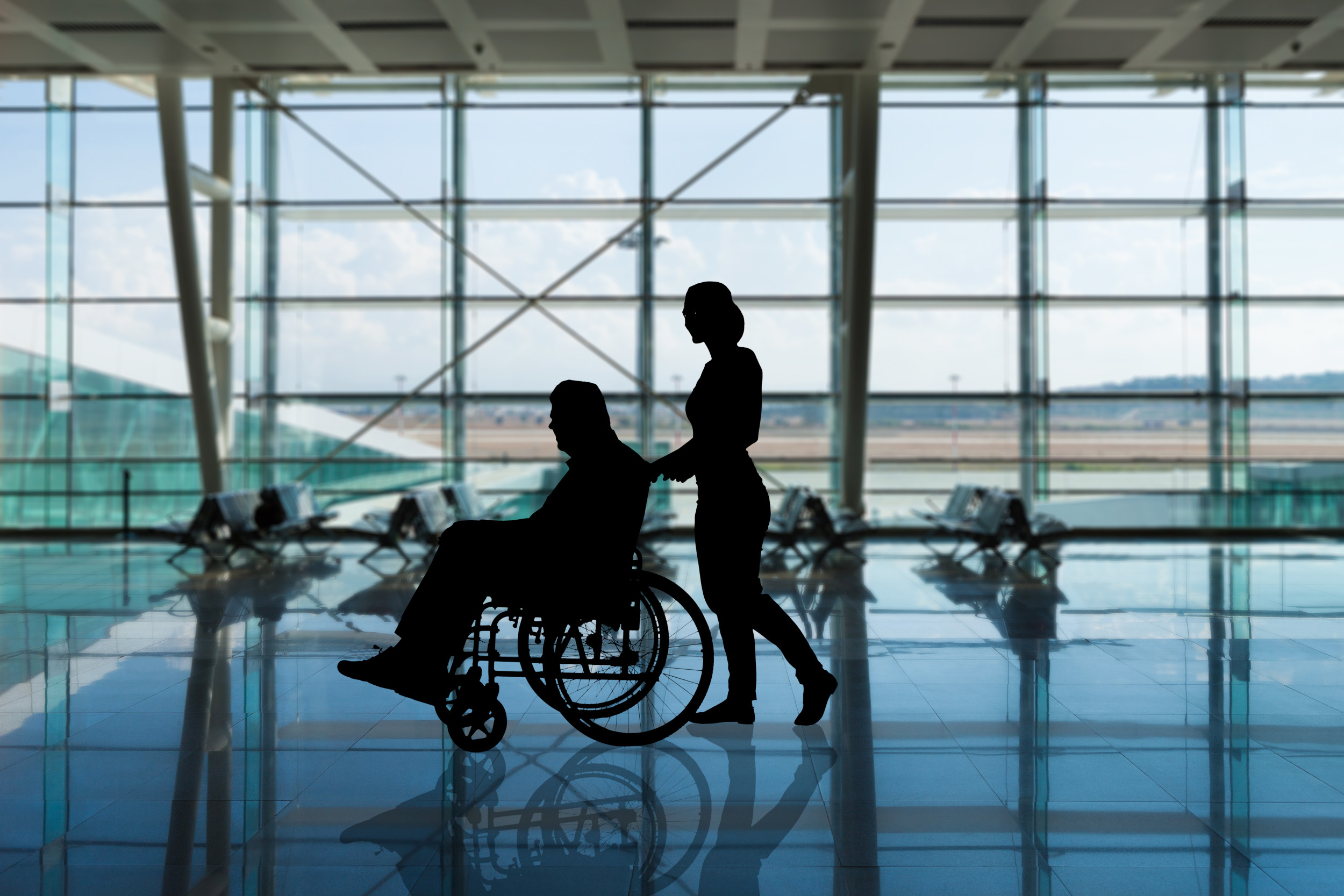
The CEO of Heathrow Airport told the Leading Britain’s Conversation (LBC) radio station that the airport has as many people working in its passenger support team as it had before the pandemic. However, the demand for it has increased “significantly.” This was in response to complaints that 20 disabled passengers had been left without assistance at Terminal 3.
Holland-Kaye said, “Some of this (demand) is because people are using the wheelchair support to try and get fast-tracked through the airport. That is absolutely the wrong thing to be doing.” He added, “if you go on TikTok, you’ll see it is one of the travel hacks that people are recommending.”
The issue of passengers faking disabilities was first raised earlier in June, with transport secretary Grant Shapps made aware of the problem. 28 year old Wolf Jenkins, took one of his shoes and socks off on TikTok to demonstrate how he faked a limp at the airport to get through security faster, while travelling from Turkey to Bristol. In another video, while travelling back to the UK from Ibiza, he is shown grinning and laughing in the wheelchair while his voiceover says, “wheelchair secured.”
Delta Airlines reported a quarterly profit of $375 million and said it expected strong demand to continue into the fall. While their revenues are increasing, their profits are still below where they were. Jet fuel comprises a significant part of operating costs, has fallen from record highs this spring but it is well above historic levels. The industry is also contending with increased spending related to its operational troubles as it seeks to recruit, hire and train new staff to keep up with demand. (source: NY times)
Hopefully this has given the airlines a heads-up for what to expect around Christmas season. They have enough time to prepare and staff sufficiently to avoid such problems in the winter season. Will they be able to bounce back?





 The Echo-nomist
Leave a comment