
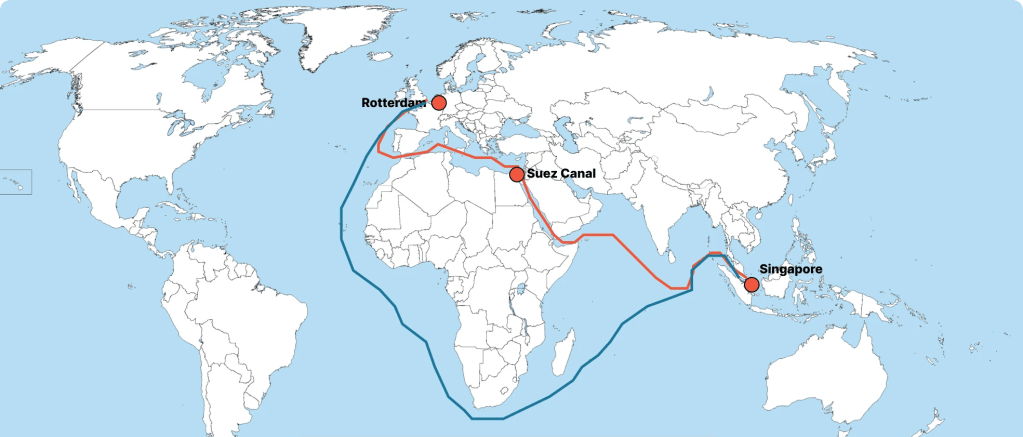
Container ships travelling from Europe to Asia are in for a long ride as they have to swing around Africa, through the Cape of Good Hope, to complete their journey. It’s a route they’re not used to as it has been largely obsolete since the opening of the Suez Canal more than 150 years ago.
The ongoing Israel-Hamas war is escalating into a wider conflict, with countries around the world taking sides. The Houthi rebels in the Middle Eastern country of Yemen have made their stance clear as they stand in solidarity with their Palestinian allies. They announced that they’re ready to target any ship travelling to Israel. In November, they seized a cargo ship and took it to a port in Yemen, claiming that it was an Israeli cargo ship.
Maersk, one of the world’s biggest shipping companies announced that they weren’t routing their ships through the Red Sea. “Following the near-miss incident involving Maersk Gibraltar yesterday and yet another attack on a container vessel today, we have instructed all Maersk vessels in the area bound to pass through the Bab al-Mandab Strait to pause their journey until further notice.”

The Bab al-Mandab strait is a 32km wide channel that sits between Yemen on the Arabian Peninsula and Djibouti and Eritrea on the African coast. In order to reach the Suez Canal, you have to pass through this strait. The Suez Canal saves a lot of time and distance for the ships that sail between the Mediterranean Sea and the Indian Ocean. If not for this canal, the ships would have to go all around Africa via. the Cape of Good Hope, to reach Indian Ocean. The route around Africa adds an additional 3,200 miles and nine extra days of travel on a typical journey between Asia and Europe.
Following Maersk’s announcement, Hapag-Lloyd and Cosco have stopped shipments through the Red Sea. The oil company BP is also joining them. About 50 vessels go through the Suez Canal a day, and recent data suggested that, as of Monday, at least 32 had been diverted. To put it into perspective, the value of cargo carried by those 32 ships is $80 billion (source: Forbes).
This comes at a time when the Panama Canal, responsible for 5% of global trade, is dealing with a drought, causing it to run at just 55% capacity.

Both, the Panama Canal and Suez Canal, being crucial to world trade, have raised questions about the supply chain. Around 12% of the global trade passes through the Red Sea and 10% of maritime oil trade. In other words, it’s the most densely used trade route on the planet. Do you remember how big a deal it was when the container ship Ever Given got stuck in the Suez Canal in 2021?
Due to the ongoing conflict in Russia and Ukraine, many European countries have stopped importing oil from Russia. This, in turn, has increased their reliance on shipborne oil and natural gas which is primarily sourced through the Middle East. That’s a little problematic since companies don’t want to go through the Red Sea. It’s also an issue for Asian countries like India and China, that are importing oil from Russia, since Red Sea is the most convenient route for them as well.
For the last two months oil prices have been falling, thanks to slackening demand in major consumers like China, but it rose by 1.2% to $80 a barrel on Wednesday. When BP announced that they were suspending their Red Sea shipments of liquefied natural gas, the price of European natural gas jumped 7%. (source: Guardian)
The issue for shipping companies is more than the risk to their vessels, cargo and crews but also the cost of insuring against that risk! The war risk premiums charged by insurance companies for travelling through the red sea have already increased from 0.07% of the ship’s value in early December, to around 0.5% now (source: Vox). We’re talking about tankers that cost hundreds of millions of dollars, so these premiums could make shipping through the Red Sea prohibitively expensive if they rise further.

The knock-on implications for global inflation and supply chain delays depend on how long this persists and whether other shocks pile on. Either way, the effects probably won’t be as pronounced as the pandemic.
UPDATE:
The conflict doesn’t seem to be dying down. The attacks have only escalated in the past week. Maersk and a few other countries had resumed shipping after talks led by the US. Helicopters launched from US navy warships were used to repel attacks on a ship owned by Maersk, causing them to cease shipping through the Red Sea again. The insurance premium for cargo ships continues to increase, as do shipping delays.




 The Echo-nomist
Leave a comment