

“Live your eyeliner, breathe your lipstick.” Seems like everyone has been taking Lady Gaga pretty seriously during the pandemic!
Turns out, lipstick sales can actually be taken as an indicator for how the economy is doing. This is known as the lipstick effect or lipstick indicator.
The lipstick effect is a theory that during an economic and/or financial crisis, consumers are more willing to spend money on less costly indulgences, rather than luxury goods. It was coined by former Estee Lauder chairman, Leonard Lauder following the dot-com bubble burst and the 9/11 attacks, which sent the US economy into recession in 2000-01. Leonard made a perplexing observation in the wake of the attacks- the company’s lipstick sales had almost doubled (source: Bloomberg). This was weird because the were dealing with a recession!
This theory claims that in an unstable economy, people buy more small, affordable luxuries (like- lipstick, eyeliner etc.). They cannot afford more expensive items, so they fulfil their wants with comparatively cheaper items. Advocates of this theory saw a substantial increase even during the Great Depression!

Interestingly, lipsticks add more than just a colour to your lips. In a research conducted by Edith Cowan University, they interviewed 300 women who use lipstick. 85% of the women said they felt “very confident” and 82% said it makes them feel “really good about themselves.” On the other hand, only 28% claimed that lipstick made them feel “attractive to the opposite sex.”
Now, during the pandemic, we can see the emergence of the lipstick effect once again. People are spending less on luxury items and more on low cost items. They do this to fulfil their wants, not needs, and stay within a reasonable budget. Makes sense.
Lipstick effect doesn’t just mean the sale of lipsticks, it also includes other low cost products. Because of the pandemic, wearing lipstick isn’t that useful because it’s hidden under the mask. Which is why, people are focusing on personal care and eye makeup- eye-liner, eye definer, mascara, fake lashes and the like. Chris Ventri, the vice president of SSA and Company, is calling this “the Longwear Foundation (or Mascara) Effect.”



Sanjiv Mehta, the chairman and managing director of Hindustan Unilever Limited (HUL), told analysts that the company’s premium personal care products grew at twice the pace of the rest of the portfolio for the quarter ended June 30, 2021 (source: Mint). Their “beauty and personal care” segment, from the previous year. The share of this segment in the total revenue of the firm is 39% (more than any other segment). In the FY21, beauty and personal care fetched them a whopping ₹17,964 crore! (source: Annual report of HUL)
Nykaa also reported a surge in sales across categories. In an interview, Falguni Nayar (the founder and CEO of Nykaa), said that they attribute the rise in demand to the lipstick effect, which is distinctly visible across cities and towns (source: Mint). The sales of Manish Malhotra Beauty brand, sold on MyGlamm, doubled in the past year. The company saw a rise in demand in the personal care category surge by 50%, since pre-pandemic levels. The demand has gone up 20-75% among other product categories as well. MyGlamm also reported an increase in the demand for lipsticks.
Another reason for demand for personal care products can be hand-sanitizing and handwashing. Due to the coronavirus, most people have been excessively washing, sanitizing their hands. This causes dry hands and develops a habit of carrying around a bottle of cream. Sales for Avene’s hand cream have tripled in the past few weeks in America, probably because of the above stated reasons (source: NY Times).

But the lipstick effect might not hold true for this pandemic. The theory doesn’t have enough evidence to prove that it holds true in every situation. It has been debunked in the past with evidence of rise in lipstick sales even in times of economic boom. This means that even though people do like to indulge in small luxuries during economic recessions, it doesn’t imply that they wouldn’t indulge in them during prosperous times.
However, there isn’t enough data and supporting evidence to definitely prove or debunk the theory. People have different opinions about its relevance.
Coming back to the pandemic… It might not actually apply here. The higher sales could be because the world has started opening up again, people are going out. People wear makeup in public to feel more confident and comfortable in public. I mean, you got to look your best if you’re stepping out! But again, the lipstick won’t even show because of your mask. It’s too early to tell if the lipstick effect is actually at play here. Maybe it’ll be clear when we have some more data.
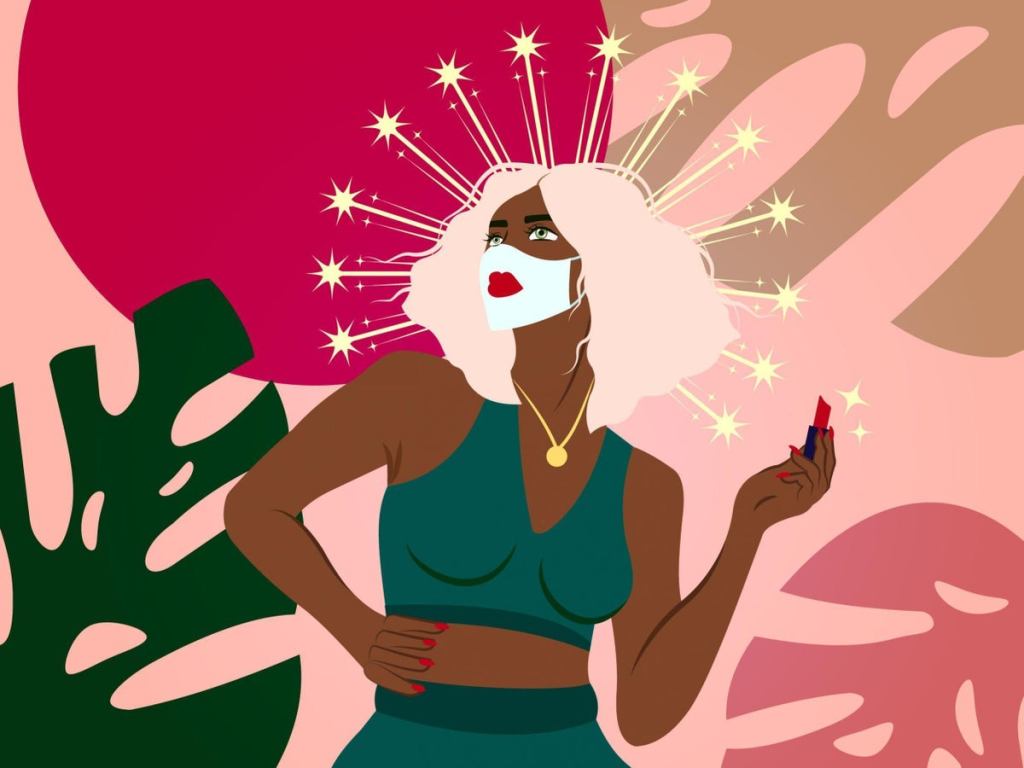
Lauder’s lipstick index might not be entirely true for our current situation, but that doesn’t mean it isn’t a good time to buy lipstick! Companies are coming out with new shades and makeup collabs because, for whatever reason, their demand is rising. Happy shopping to you 💄





 The Echo-nomist
Leave a comment